Making the Invisible
Bankable.
The ESG Asset Attribution Model (EAAM) is an open methodology that quantifies the environmental services generated by regenerative aquaculture farms — and translates them into a standardised, bankable asset class.
A documented $4.73 billion in ecosystem services, invisible to finance.
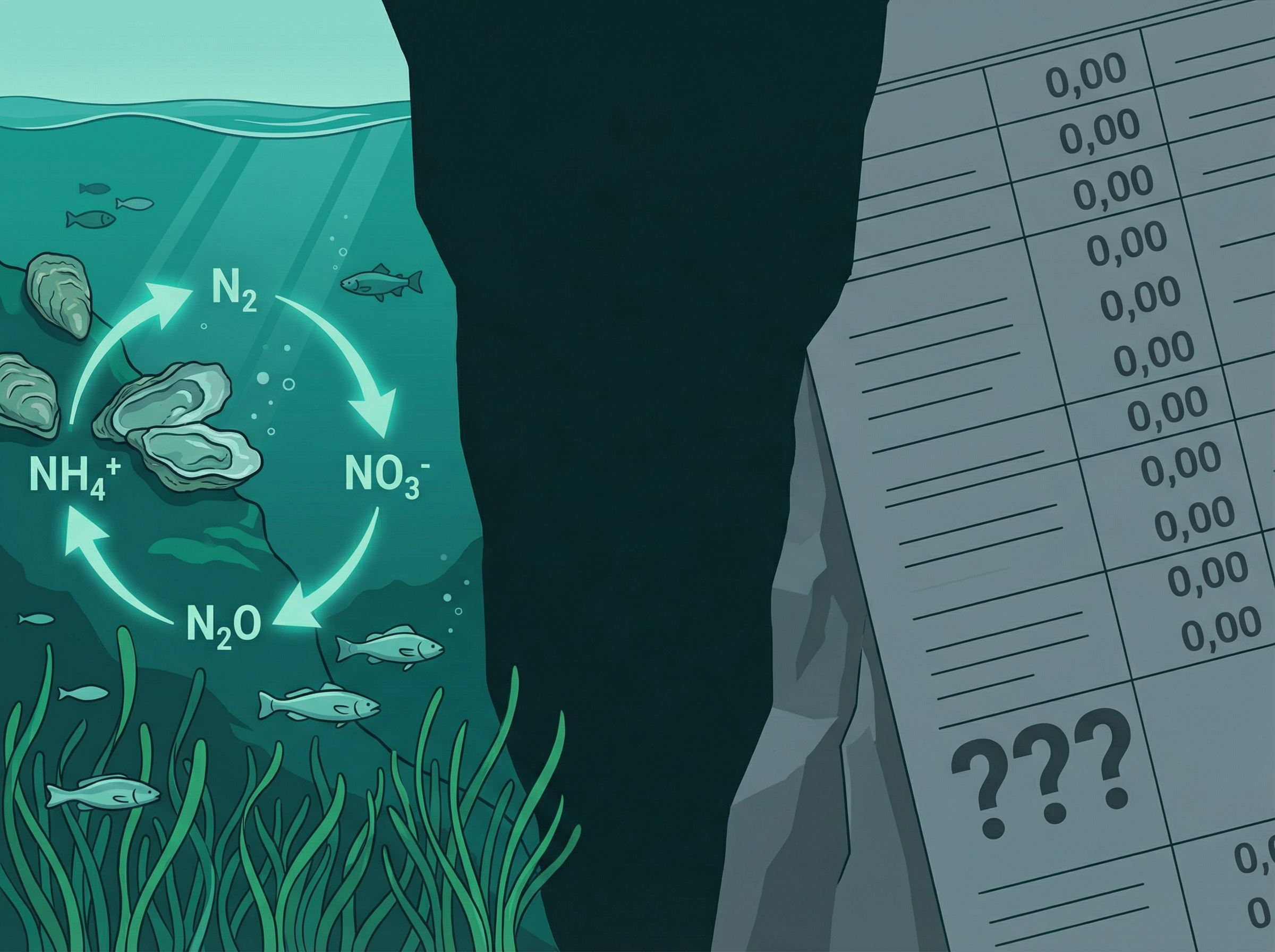
Oyster farms are among the most productive ecological assets on the planet. A single hectare of well-managed oysters can filter over a billion litres of water per day, remove hundreds of kilograms of nitrogen from coastal waterways, and support biodiversity at levels 135% above baseline. The average US West Coast farm generates an estimated $68,376 per year in ecosystem services — equivalent to 7.7% of its production value.
Yet when a farmer walks into a bank, none of this value appears on the balance sheet. Traditional collateral models see only the physical assets — the baskets, the lease, the boat. The ecological contribution is invisible. This is the Aquaculture Capital Gap, and it is costing the industry, the environment, and the economy. Globally, an estimated 90% of regenerative farms are excluded from natural capital markets — not because they lack environmental performance, but because the cost of proving that performance exceeds its financial reward.
"No comparable model exists that combines operations-embedded MRV with a dual-flow framework, a performance delta diagnostic, and a data quality-linked financial haircut mechanism — all calibrated specifically for the fragmented, small-scale aquaculture sector. The EAAM's core innovation directly addresses a structural market failure that has excluded approximately 90% of regenerative farms from natural capital markets globally."
A dual-flow methodology that bridges ecology and capital markets.
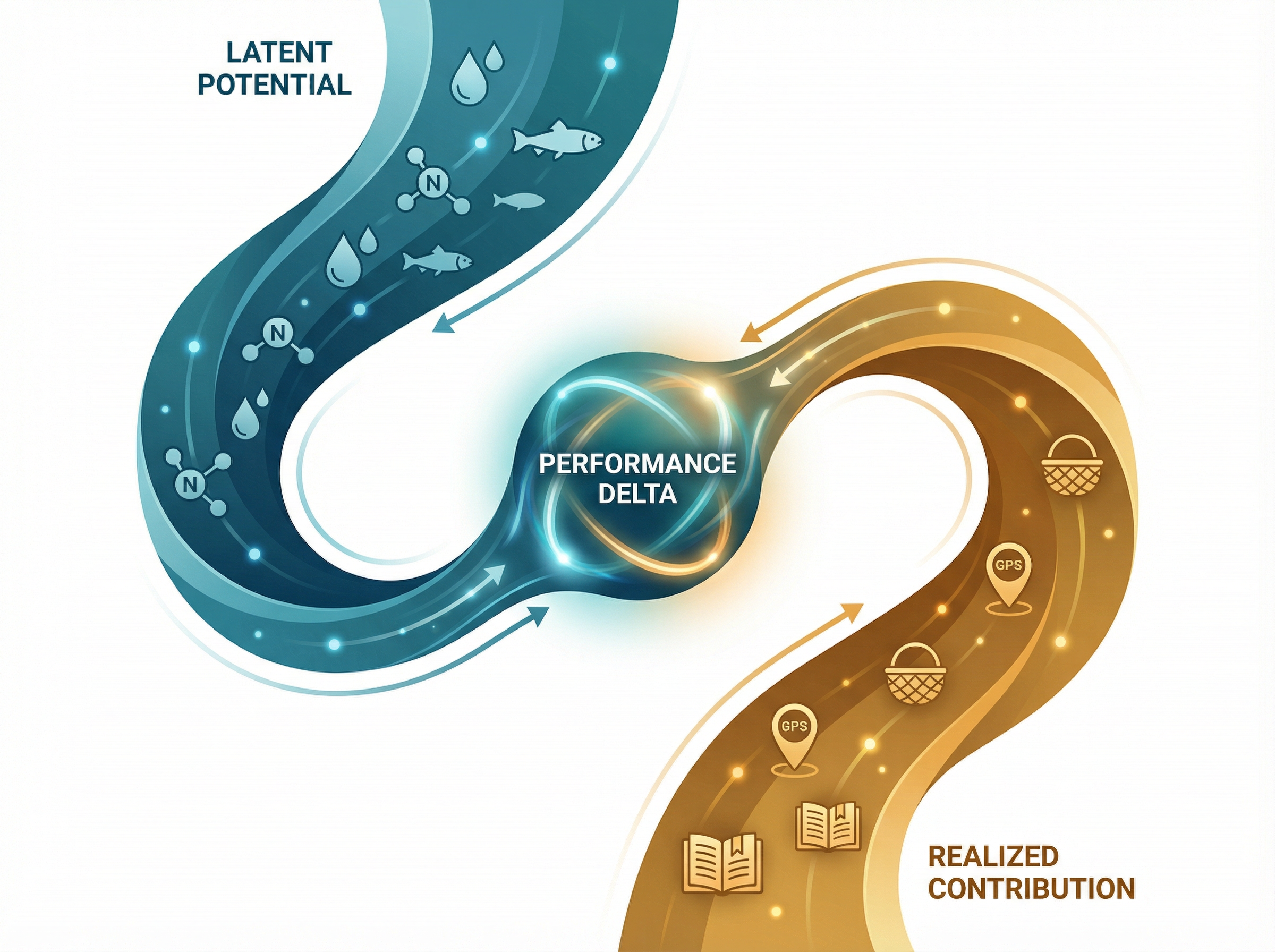
The EAAM uses a Dual-Flow Methodology to calculate the bankable ESG value of a farm. A Top-Down flow assesses the Latent Potential of a lease — what the ecosystem could deliver under optimal conditions. A Bottom-Up flow measures the Realized Contribution — what the farm is actually delivering, verified through operational data.
The gap between the two — the Performance Delta — becomes the farmer's funding prospectus. The greater the unrealised potential, the greater the opportunity for impact investors and lenders to direct capital toward restoration. For a single 1-hectare farm transitioning to the Reference Cultivation Scenario, the EAAM estimates an annual financial opportunity of $9,110–$25,120 — comprising nutrient trading, regulatory incentives, green financing savings, and ecosystem service markets.
Four ecosystem services. One bankable score.
Nitrogen Removal
Oysters remove nitrogen from the water column through bioextraction and by enhancing sediment denitrification — the conversion of dissolved nitrogen to inert gas. Both pathways are quantified and valued against nutrient credit market rates.
Water Filtration
A single oyster filters 20–50 litres of water per day, removing suspended particles, algae, and pathogens. At farm scale, this service contributes materially to water quality in impaired coastal systems.
Habitat Provision
Oyster farm structures provide complex three-dimensional habitat that supports fish, invertebrates, and other species at densities 135% above baseline. This biodiversity enhancement is valued using published meta-analyses of wild fish production.
Carbon Dynamics
Recent research demonstrates oyster farming acts as a marine carbon dioxide removal hotspot, with a 2.39× multiplier for organic carbon deposition. The EAAM applies a conservative two-tier framework pending further scientific consensus.
Data quality as a financial instrument.
The EAAM's Data Quality Score (DQS) applies a risk-adjustment "haircut" to attributed ESG value based on the fidelity of the underlying farm data. This mechanism — borrowed from credit ratings methodology — maintains environmental integrity without imposing the cost of physical sampling.
The result is a powerful incentive: a farmer who upgrades from paper logbooks to GPS-verified digital records can increase their bankable ESG value by up to 33% — without changing a single oyster in the water. Data quality becomes a direct pathway to lower cost of capital.
Three domains of expertise. One shared goal.
The EAAM is being built through a structured collaboration between scientific, finance, and industry expertise. Each domain contributes something the others cannot — and each gains something unique from participation. Click any card to see what we are looking for and what you will gain.
Co-author a methodology that will shape the field.
The EAAM is designed to be published as an open, peer-reviewed methodology. We are seeking scientific institutions to validate our ecosystem service coefficients, challenge our assumptions, and co-author the Core Reference Manual — ensuring the methodology meets the highest standards of scientific rigour before it reaches institutional investors and regulators.
Structure the first ESG-linked aquaculture loans with verified data.
The global Sustainability-Linked Loan market reached $907 billion in 2024 — but small aquaculture operators have been locked out for want of verifiable ESG data. The EAAM provides exactly the standardised, auditable, platform-integrated data stream that SLL covenant structures require. We are seeking lenders to participate in the first ESG-linked farm asset finance trials.
Help build the standard that will define your sector's access to capital.
Oyster, mussel, and seaweed farmers generate measurable, valuable ecosystem services every day. The EAAM is being built to make that value bankable — but it needs to be grounded in the realities of farm operations. We are seeking farmers, industry associations, and aquaculture businesses to contribute operational expertise, farm data, and on-the-ground knowledge to the trial programme.
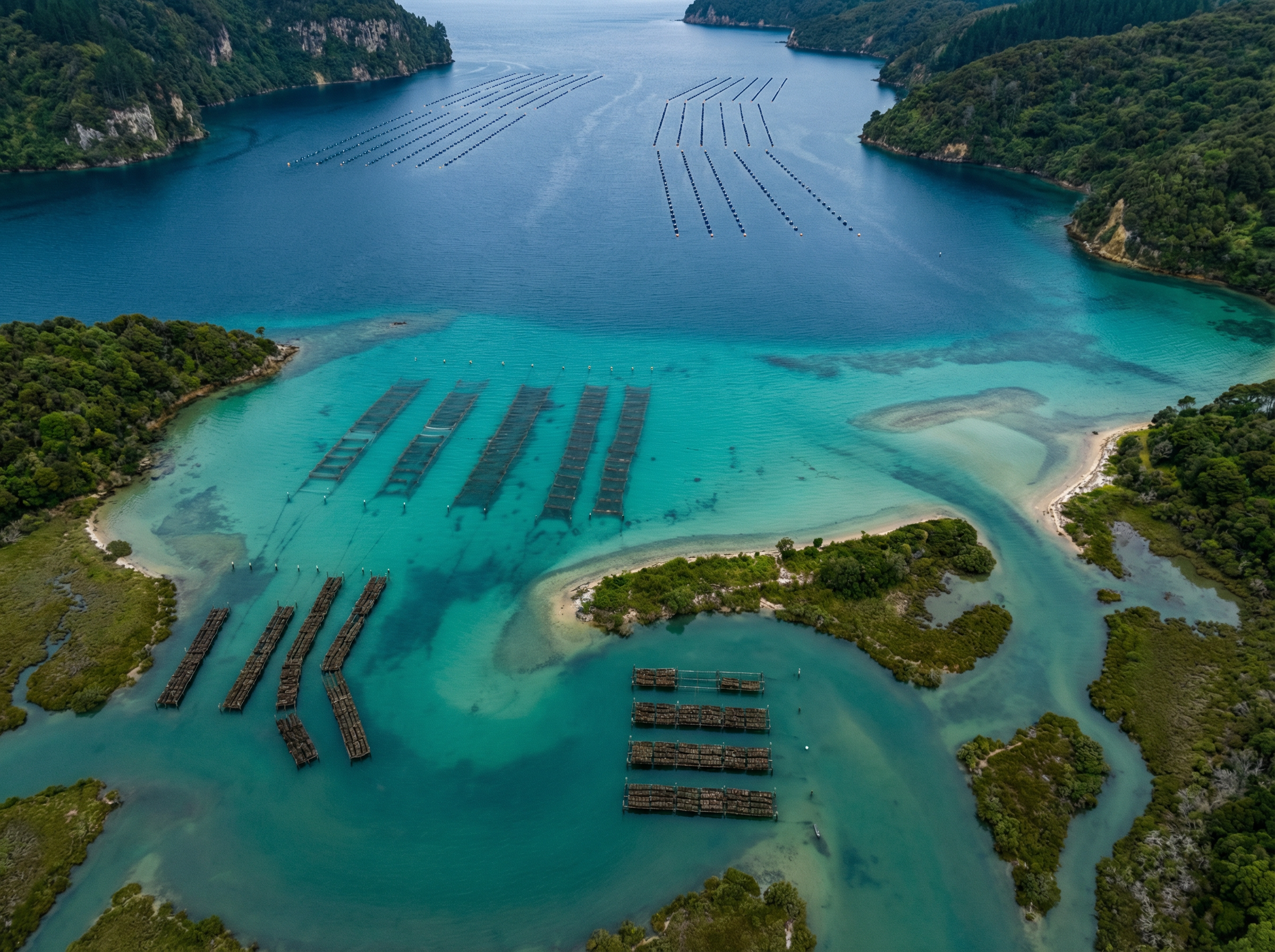
The EAAM is designed from the outset as an open, portable methodology. The US oyster sector is the proving ground — but the framework is built to be adapted by any regenerative aquaculture operation, anywhere in the world. The global "no-feed" marine aquaculture sector spans an estimated 597,000 farms, the vast majority of which are smallholders currently excluded from natural capital markets.
Mussel farmers in Norway and seaweed cultivators in Indonesia all generate measurable ecosystem services. The EAAM provides the standardised language to make those services bankable — and the open-source architecture to make adaptation straightforward. The goal is not to own the standard, but to catalyse it.
Funded by NOAA. Currently seeking collaborators.
Methodology Development
Core EAAM framework, Dual-Flow Methodology, Master Attribution Formula, and Core Reference Manual v0.1 developed and documented.
Scientific Validation
Engaging scientific institutions to validate ecosystem service coefficients, challenge assumptions, and co-author the Core Reference Manual.
Finance Trials
Identifying finance providers to participate in the first ESG-linked farm asset finance trials across multiple farm scenarios and regions.
Open Publication
Publishing the Core Reference Manual, trial case studies, and commercialisation strategy as open-access resources to catalyse global adoption.
This methodology will only be as strong as the people who build it.
We are not looking for passive endorsers. We are looking for scientists who will challenge our coefficients, lenders who will co-design the loan structures, and farmers who will tell us where the model breaks against reality.
The EAAM will be published as an open methodology. The institutions and individuals who contribute to its development will be named in the Core Reference Manual and associated publications — and will have shaped a standard that could redefine how the world values regenerative food systems.
We respond to all enquiries personally. [email protected]